
When William L. first walked into Simpson Housing Services as a Shelter Support volunteer, he wasn’t entirely sure what to expect. After spending 15 years living in South Korea as a university professor, he had recently returned to Minnesota to pursue a nursing degree at Normandale Community College. His interest in mental and community health led him to seek volunteer experiences that aligned with his values — and Simpson quickly stood out as the right fit.
Nearly a year later, what began as a way to complete volunteer hours has become something much more meaningful. Through everyday conversations, shared tasks, and simple moments of connection, William discovered that the Shelter Support role offers something valuable for everyone.
A Role Built on Presence, Not Expertise
Although William is finishing nursing school, he’s quick to point out that the role itself doesn’t require medical knowledge or specialized skills. Shelter Support volunteers help with everyday needs that keep the shelter running smoothly: restocking supplies, helping in the kitchen, setting up coffee, assisting with meals, or simply being available to talk with guests.
The flexibility of the role makes it accessible for many volunteers. Shifts are available in the evening seven days a week and just mornings and afternoons on the weekends.
What surprised him most early on was how natural the experience felt. Having grown up in a smaller community and spending much of his adult life overseas, he hadn’t previously worked closely with people experiencing homelessness. But the uncertainty faded quickly.
“Everybody is always nice. You realize very quickly people experiencing homelessness are just part of our community — just like everybody else,” William says.
Shelter Support volunteers aren’t expected to solve problems or provide professional services. A typical shift might include restocking supplies, setting up coffee, assisting in the kitchen, washing dishes, or organizing common spaces. Volunteers may spend time greeting guests, answering simple questions, or just chatting and being present while staff handle any complex situations. Some shifts are busy and hands-on, while others are quieter, offering time for conversation and connection. The goal isn’t expertise — it’s reliability, kindness, and a willingness to offer support wherever it’s needed.
The Learning Happens in the Conversations
While some volunteer roles focus heavily on tasks, William found that the most impactful moments often came through simple conversations. One interaction that stayed with him involved a guest who shared his deep knowledge of bicycles. As someone who bikes himself, William found the two quickly bonding over repairs and technical details.
“In that moment, you kind of forget that you’re at a shelter,” he says. “You’re just talking about something you both enjoy.”
Experiences like that challenged assumptions he didn’t even realize he had. He came to see guests not through the lens of circumstance, but as individuals with interests, intelligence, and stories — people who simply found themselves in difficult situations.
That realization, he says, has been one of the most important lessons of his time at Simpson.
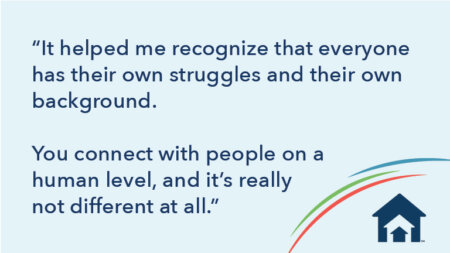
“It helped me recognize that everyone has their own struggles and their own background. You connect with people on a human level, and it’s really not different at all.”
A Real-World Education in Community
For William, the experience has also shaped the kind of nurse he hopes to become. Initially drawn to psychiatric nursing, he now feels a growing interest in community health and working directly with underserved populations. Volunteering allowed him to see firsthand how social factors — housing, access to care, mental health, and support systems — influence overall well-being.
But he emphasizes that this learning isn’t limited to people pursuing healthcare careers.
“You don’t have to be in nursing or social work,” he says. “Even if you’re an accountant volunteering once a week, you get to know this community in a way you normally wouldn’t.”
The role also offers insight into how organizations like Simpson operate — doing meaningful work with support from the community and volunteers to expand what’s possible. Seeing Simpson Community Shelter and Apartments in action has been especially inspiring for him, demonstrating what can happen when people come together around a shared mission and values.
An Experience That Stays With You
William describes Shelter Support as a “real” experience. Some days are busy, others quieter. Some shifts are filled with conversation, while others focus on helping behind the scenes. But every shift offers something different — a new perspective, a new interaction, or a deeper understanding of the community.
“It’s not glamorous,” he says. “But it’s valuable. You’ll gain something from it.”
For those considering volunteering but feeling unsure or nervous, his advice is simple: come with an open mind. The role isn’t about having all the answers. It’s about being present, helping where needed, and recognizing the shared humanity in every interaction.
To learn more about becoming a Shelter Support Volunteer, email Katelyn or fill out an application here.