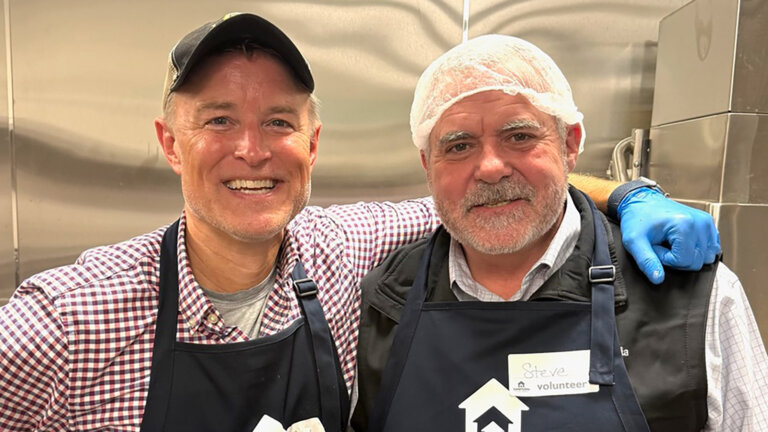
When Mike B. first signed up to serve breakfast at Simpson Housing Services nearly fifteen years ago, his goal was simple. He and his wife wanted to find a way to volunteer together as a family — something meaningful that could involve their young children and help them understand the importance of giving back.
At the time, their kids were seven, five, and two years old. Like many parents, Mike was looking for ways to introduce service early, even if that meant starting small. Serving a meal felt approachable. It was tangible. You could show up, cook, serve, and help someone in a real and immediate way.
That first breakfast led to another. Soon, Mike became a team captain through his church, St. Thomas the Apostle, helping organize regular meal teams. Over time, the partnership grew from a few volunteers into multiple teams serving regularly at Simpson. What began as a one-time family activity became a lasting part of his life.
And along the way, his understanding of service changed.
Music, Chess and Shared Humanity
In the early days at the original shelter, serving meals was a full operation. Volunteers planned menus, shopped for groceries, transported food, cooked, served, and cleaned — often for 75 to 125 guests in a single evening. The focus was practical: make sure the meal was nutritious, make sure no one went hungry, and make sure everything ran on time.
But once the logistics became familiar, something shifted.
“It became less about serving dinner,” Mike says, “and more about hosting.” Volunteers slowed down, sat at tables, refilled drinks, and talked with guests. A music lover, Mike made sure music was always playing in the background. Kids helped at the dessert table. Conversations happened naturally. Laughter followed.
What stood out most were the unscripted moments — the ones that reminded everyone involved that volunteers and guests are all simply people wanting to connect.
One evening, while wiping down tables, Mike noticed two men playing chess on a large board. One player moved quickly and confidently. Curious, Mike learned that the man was a grandmaster-level chess player. Mike brought his young son over to watch, and soon the guest was teaching him about the game.
There were other moments too: conversations with a former professional soccer player whose life had been derailed by medical challenges, or guests whose backgrounds included careers in medicine or finance. Each interaction chipped away at stereotypes and replaced them with something more honest — shared humanity.
Read what Mike’s son Henry thinks about the experience now as an adult.
A Birthday, a Bouquet, and the Little Things
Recently, Mike served his first meal at the new Simpson Community Shelter & Apartments. The experience was different in many ways — and better.
Where volunteers once carried the pressure of cooking and coordinating entire meals, the new model allows them to focus more fully on connection. Meals are professionally prepared by Simpson’s chefs, the space is open and dignified, and volunteers can spend more time talking with guests rather than worrying about meal planning, shopping and logistics.
That shift created space for moments like the one Mike experienced during his most recent visit.
While refilling drinks, he struck up a conversation with a woman wearing a sweatshirt referencing Brooklyn. They talked about where they were from, family, and life experiences. She mentioned it was her birthday.
Mike stepped away and returned with a small bouquet of flowers the volunteer team had brought to brighten the dining room. “Happy birthday,” he told her, handing her the roses.
It was a small gesture. But as Mike has learned over the years, small things often matter most.
“The little things are the big things,” he says. “You’re not changing the world in one moment. But those moments add up.”
A Community That Shows Up
Mike is originally from Atlanta, and has lived in New York, Chicago, London, and other cities around the world. Each place had its strengths, but he says Minnesota’s sense of community stands apart.
Here, he’s noticed, people respond when help is needed. Volunteers show up willingly. Neighbors help neighbors. There’s a shared understanding that community responsibility belongs to everyone.
That spirit is part of what keeps him coming back to Simpson.
Serving meals isn’t a one-sided act of giving, he explains. Volunteers leave feeling just as filled up as the people they came to serve.
“It’s not a zero-sum thing,” he says. “The pie gets bigger. Everyone walks away better.”
Click to learn more or sign up to serve meals in our Cook & Connect program.
Contact Aaron via email with questions about Cook & Connect.